Cisco's CCNA certification consists of 2 exams:
1. CCENT (stands for Cisco Certified Entry Network Technician) exam, and
2. CCNA ICND (ICND stands for Interconnecting Cisco Network Devices).
One can also pass CCNA directly by taking one exam option (640-802)
For beginners, two exam track is the preferred method of study. SimulationExams.com offers practice tests for all the exam tracks as below:
CCENT 640-822 Exam
CCNA ICND 640-816 Exam
CCNA 640-802 Exam
Downloads consist of free demo version of the exam. Interested candidates may purchase full version of the tests at Cisco Exams section of simulationexams.com
Online version of the exams is available from CertExams.com.
Register online and take demo online tests at CertExams.com
1. CCENT 640-822 Online Tests
2. CCNA ICND 640-816 Online Tests
3. CCNA 640-802 Online Tests
Several other cisco certifications are also available. Please visit the website for details.
Wednesday, August 27, 2008

Saturday, November 10, 2007
CCNA ICND2 Practice Tests
SimulationExams.com, recently released CCNA ICND2 (Interconnecting Cisco Network Devices 2) practice tests. ICND2 exam counts toward CCNA certification awarded by Cisco Systems®. CCNA ICND2 isintended for candidates who have experience in configuration and troubleshootingof Cisco networking devices.. The practice tests offered by SimulationExamsprovide a simulated test environment for candidates before appearing for thecertification exam.
The advantages of a simulated exam are:
- Ability to gauge one's preparedness to take actual certification exam
- To strengthen weak areas
- To familiarize oneself with actual exam environment (such as timed test, lab practice, relevant practice questions, etc.)
CCNA ICND2 is one of the two qualifying exams available to candidates pursuing a two-exam option for Cisco Certified Network Associate Certification. To achieve CCNA, one need to pass both CCENT (also known as CCNA ICND1), and the CCNA ICND2 exams. Alternatively, one can obtain CCNA certification by passing a single exam, 640-802.
Related exam: CCNA ICND1
Disclaimer: SimulationExams.com is neither associated nor affiliated with Comptia®, Microsoft®, Cisco Systems® or any other Company. All trademarks are duly recognized.
Saturday, November 03, 2007
VTP Trunking Protocol
VLAN Trunking Protocol
VTP sends messages between trunked switches to maintain VLANs on these switches in order to properly trunk.
VTP is a Cisco proprietary method of managing VLANs between switches and runs across any type of trunking mechanism.
VTP messages are exchanged between switches within a common VTP domain.
VTP domains must be defined or VTP disabled before a VLAN can be created.
Exchanges of VTP information can be controlled by passwords.
VTP manages only VLANs 2 through 1002.
VTP allows switches to synchronize their VLANs based on a configuration revision number.
Switches can operate in one of three VTP modes: server, transparent, or client.
VTP can prune unneeded VLANs from trunk links.
Monday, October 30, 2006
CCNA Exam Trainer
Announcement:
CCNA Exam Trainer is available from certexams.com.
The ccna training software has the following features:
CCNA Practice Questions
CCNA Exam Trainer is available from certexams.com.
The ccna training software has the following features:
CCNA Practice Questions
-
Multiple choice single answer
-
Multiple choice multiple answers
-
True/False Type questions
-
Drag-n-drop Type questions
-
Set question randomization
-
Set number of questions for exam
-
Set answer randomization
-
Save and manage results
-
Enable/disable options with a password
-
Simulate a router network
-
Design a router network
-
Use existing network labs to gain experience
Sunday, September 17, 2006
CCNA Tutorial
A brief tutorial on ccna is available at simulationexams.com. The contents of the tutorial are given below:
- IP Addressing
- Subnet masking -I
- Subnet masking -II
- Routing Fundamentals
- Cisco IOS
- Access Control Lists (ACL)
- Wide Area Networks
- VLANs
- VLAN Fundamentals
- Types of VLANs
- VLAN Routing
Simulationexams.com provides ccna practice tests that are suitable for candidates preparing for taking CCNA certification exam.
Monday, July 31, 2006
Networking Primer -IP Addressing
An IP address is a unique logical identifier for a node or host connection on an IP network. An IP address is a 32 bit binary number, and represented as 4 decimal values of 8 bits each. The decimal values range from 0 to 255. This is known as "dotted decimal" notation.
There are 5 different address classes. You can determine which class any IP
address is in by examining the first 4 bits of the IP address.
There are three IP network addresses reserved for private networks. The addresses are 10.0.0.0/8, 172.16.0.0/12, and 192.168.0.0/16. They can be used by anyone setting up internal IP networks, such as an intranet. Internet routers never forward the private addresses over the public Internet.
Example: 192.189.210.078
It is sometimes useful to view the values in their binary form.
192     .189     .210     .078
11000000.10111101.11010010.01001110
Every IP address consists of network identifier and node identifier. The IP network is divided based on Class of network. The class of network is determined by the leading bits of the IP address as shown below.
Address Classes
There are 5 different address classes. You can determine which class any IP
address is in by examining the first 4 bits of the IP address.
- Class A addresses begin with 0xxx, or 1 to 126 decimal.
- Class B addresses begin with 10xx, or 128 to 191 decimal.
- Class C addresses begin with 110x, or 192 to 223 decimal.
- Class D addresses begin with 1110, or 224 to 239 decimal.
- Class E addresses begin with 1111, or 240 to 254 decimal.
Addresses beginning with 01111111, or 127 decimal, are reserved for loopback and for internal testing on a local machine. Class D addresses are reserved for multicasting. Class E addresses are reserved for future use. They should not be used for host addresses.
Now we can see how the Class determines, by default, which part of the IP address belongs to the network (N) and which part belongs to the Host/node (H).
- Class A: NNNNNNNN.HHHHHHHH.HHHHHHHH.HHHHHHHH
- Class B: NNNNNNNN.NNNNNNNN.HHHHHHHH.HHHHHHHH
- Class C: NNNNNNNN.NNNNNNNN.NNNNNNNN.HHHHHHHH
In the example, 192.189.210.078 is a Class C address so by default the Network part of the address (also known as the Network Address) is defined by the first three octets (192.189.210.XXX) and the node part is defined by the last one octets (XXX.XXX.XXX.078).
In order to specify the network address for a given IP address, the node section is set to all "0"s. In our example, 192.189.210.0 specifies the network address for 192.189.210.078. When the node section is set to all "1"s, it specifies a broadcast that is sent to all hosts on the network. 192.189.210.255 specifies the broadcast address.
Private Subnets
There are three IP network addresses reserved for private networks. The addresses are 10.0.0.0/8, 172.16.0.0/12, and 192.168.0.0/16. They can be used by anyone setting up internal IP networks, such as an intranet. Internet routers never forward the private addresses over the public Internet.
Saturday, June 24, 2006
CCNA Intro and CCNA ICND exams.
There is a two-exam option for attaining ccna certification. Here, you need to pass two individual exams, namely CCNA Intro and CCNA ICND for attaining ccna certificate. This stream is useful for candidate who are new to networking, and prefer slower pace of study.
See CCNA Intro exam details, and CCNA ICND exam details
Download, and practice CCNA Intro exam questions, and CCNA ICND exam questions.
The combined syllabus for CCNA Intro, and CCNA ICND is close to CCNA. If you are a working professional with atleast 1 or 2 years of experience in networking, it is suggested to take single exam path. If you are completely new to networking, it is recommended to take two-exam path.
See CCNA Intro exam details, and CCNA ICND exam details
Download, and practice CCNA Intro exam questions, and CCNA ICND exam questions.
The combined syllabus for CCNA Intro, and CCNA ICND is close to CCNA. If you are a working professional with atleast 1 or 2 years of experience in networking, it is suggested to take single exam path. If you are completely new to networking, it is recommended to take two-exam path.
Monday, May 15, 2006
CCNA Exam Cram Notes
A quick revision notes for CCNA exam is available at examguides.com The ccna exam cram notes is useful for those who are in the final stage preparation.
Wednesday, April 26, 2006
ISO OSI reference model
A comprehensive tutorial is available at tutorialsweb on ISO OSI model. OSI model is the basic building block of CCNA certification preparation, and it is highly required that a CCNA aspirant has a solid understanding of different layers of OSI model. The contents of the tutorial are given below:
- The OSI (Open Systems Interconnection) Model
- Information Exchange Process
- Relationship between the OSI Model and Networking Devices
- Repeaters, Bridges, Routers, Gateways and other network components
- Glossary of Networking Terms
Read complete tutorial on ISO OSI model for CCNA preparation.
Monday, April 24, 2006
CCNA Network Simulator
CCNA Network Simulator is a software tool that simulates a router/switch network. The tool should typically be able to:
- Simulate a router
- Simulate a switch
- Simulate a router/switch network
- Design a router/switch network
- Save semi-finished configurations, and reload for later resumption
- Save the work to a text file for later use.
A router simulator is essential for having hands-on practice. Ofcourse, if you can buy routers and switches and make physical network that would be fine, but normally does not justify the costs involved.
CCNA network simulators are available from the following sources:
http://routersimulator.certexams.com
http://www.boson.com/Product/CIS-NS-CCNA-04.html
A comprehensive CCNA trainer is available at:
http://www.certexams.com/cisco/ccna/download/ccna-trainer.html
Normally, the software is available free for demo version, and you need to pay if you want to unlock the full version. The cost range from $150 down to $25 depending on the requirements. Download, and checkout the features available.
CCNA Preparation Resources - Books, Practice Exams, Cram Notes etc.
Recommended Books: CCNA exam is available in one exam path (CNA:640-801), and two-exam path (CNA Intro: 640-821, and CCNA ICND:640-811). Given below are recommended books for both streams.
1.
 CCNA Certification Library (CCNA Self-Study, exam #640-801) (Hardcover) by Wendell odome Cisco Press Book
2.
 CCNA: Cisco Certified Network Associate, Deluxe Edition (640-801) (Hardcover) by Todd Lammle
3.
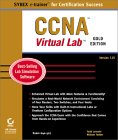
CCNA Virtual Lab, Gold Edition Sybex Press
4. Only if you are taking two-exam path to CCNA:
ICND:
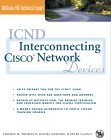 ICND Interconnecting Cisco networks
5. Only if you are taking two-exam path to CCNA:
CCNA Intro by Cisco Press
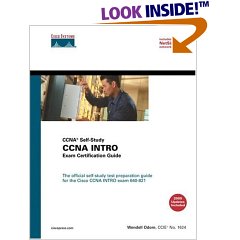 CCNA Intro by Cisco Press
6. Only if you are taking two-exam path: CCNA ICND by Cisco Press
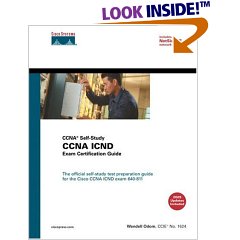 CCNA ICND by Cisco Press
1.
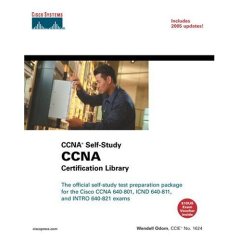 CCNA Certification Library (CCNA Self-Study, exam #640-801) (Hardcover) by Wendell odome Cisco Press Book
2.
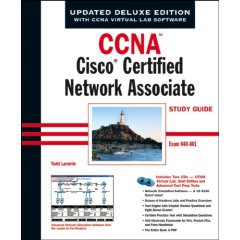 CCNA: Cisco Certified Network Associate, Deluxe Edition (640-801) (Hardcover) by Todd Lammle
3.
CCNA Virtual Lab, Gold Edition Sybex Press
4. Only if you are taking two-exam path to CCNA:
ICND:
 ICND Interconnecting Cisco networks
5. Only if you are taking two-exam path to CCNA:
CCNA Intro by Cisco Press
 CCNA Intro by Cisco Press
6. Only if you are taking two-exam path: CCNA ICND by Cisco Press
 CCNA ICND by Cisco Press
Sunday, April 23, 2006
CCNA Exam Objectives
Given below are the exam topics covered under CCNA. Cisco(R) may include additional related topics, and please visit Cisco website for most recent list of exam objectives.
Planning & Designing
- Planning and designing simple LANs using Cisco Technology
- Plan and design an IP addressing scheme to meet design requirements
- Select an appropriate routing protocol based on user requirements
- Design a simple internetwork
- Develop an access list (both standard and extended) to meet user specifications
- Choose WAN services (including FR) to meet customer requirements
Implementation & Operation
- Configure routing protocols (including RIP, RIP v2, EIGRP, and OSPF) based on
user requirements - Configure IP addresses, subnet masks, and gateway addresses on routers and hosts
- Configure a router for additional administrative functionality
- Configure a switch with VLANS and inter-switch communication
- Implement a LAN
- Customize a switch configuration to meet specified network requirements
- Manage system image and device configuration files
- Perform an initial configuration on a router and switch
- Implement access lists (both standard access lists, and extended access lists)
- Implement simple WAN protocols
Troubleshooting
- Utilize the OSI model as a guide for systematic network troubleshooting
- Perform LAN and VLAN troubleshooting
- Troubleshoot routing protocols (including RIP v1, RIP v2, OSPF, and EIGRP)
- Troubleshoot IP addressing and host configuration
- Troubleshoot a device as part of a working network
- Troubleshoot an access list (Standard access lists, extended access lists)
- Perform simple WAN troubleshooting
Technology
- Describe network communications using layered models (ISO OSI Model, and DOD
Model) - Describe the Spanning Tree process (including STP algorithm)
- Compare and contrast key characteristics of LAN environments
- Characteristics of routing protocols
- Evaluate TCP/IP communication process and its associated protocols
- Describe the components of network devices
- Study rules for packet control
- Study important characteristics of WANs
Introduction to CCNA
CCNA (Short for Cisco Certified Network Associate) is offered by Cisco Systems Inc., a US headquartered company specializing in manufacture of Networking devices and software. The certification is widely recognized in the field of networking technologies. CCNA certified candidate will typically be able to plan, configure, and operate simple routed WAN and switched LAN networks using Cisco products. 640-801 is the only exam necessary to pass for obtaining CCNA certification.
Exam details are as given below:
Exam # 640-801, CCNA (Cisco Certified Network Associate)
Number of questions 55-65
Time allowed 90
Passing score 849 **
Register for exam at VUE (www.vue.com/cisco)
Prometric (www.2test.com)
You can visit the official website at http://www.cisco.com/warp/public/10/wwtraining/certprog/testing/current_exams/640-801.htmlCertification preparation material is available from various sources.
Resources:
Exam details are as given below:
Exam # 640-801, CCNA (Cisco Certified Network Associate)
Number of questions 55-65
Time allowed 90
Passing score 849 **
Register for exam at VUE (www.vue.com/cisco)
Prometric (www.2test.com)
You can visit the official website at http://www.cisco.com/warp/public/10/wwtraining/certprog/testing/current_exams/640-801.htmlCertification preparation material is available from various sources.
Resources:
Saturday, April 22, 2006
A guide to certification exams
An article is available at simulationexams.com on certification benefits. A brief review of contents is given below.
I. Benefits of Certification:
Recognition and increased job opportunity
Proficiency in Related Technology
Equipping a fresh out of college candidate to face a job
Increased job security, and remuneration - According to CertMag.com study, certified candidates enjoyed salary increase from 10% to as high as 23%. It is also shown that more the number of certifications (higher the skill level) more the amount of compensation. See the article at www.certmag.com/issues/dec00/feature_gabelhouse.cfm.
II. Leading vendor certifications from Microsoft®, CompTIA®, Cisco®, CheckPoint®, and Prosoft®:
Microsoft®, CompTIA®, Cisco®, CheckPoint®, and Prosoft® are among the leading vendors of IT Certifications. Each vendor, in turn may have different certification tracks. For example, Microsoft has MCSE (For Networkers) track, and MCSD (for Developers) track. Usually, each track has different levels of certification aimed at the beginner, the pro, and the expert. As often said, certification is a journey, and not a destination. In fact, many certifications require re-certification after a pre-determined period of time (usually 2-3 years) to remain certified. Therefore, it is important that you choose your certification track after careful consideration of your career plan. Though there are wide range of certifications available, we confine to a few leading certification tracks: MCSE/MCSA, CCNA/CCNP, A+/Network+, CIW, and CheckPoint CCSA/CCSE.
Anyone, who is interested in pursuing certifications is recommended to go through the article, and choose appropriate certification path. View Complete article at: Guide to IT Certifications and Certification Exams
I. Benefits of Certification:
Recognition and increased job opportunity
Proficiency in Related Technology
Equipping a fresh out of college candidate to face a job
Increased job security, and remuneration - According to CertMag.com study, certified candidates enjoyed salary increase from 10% to as high as 23%. It is also shown that more the number of certifications (higher the skill level) more the amount of compensation. See the article at www.certmag.com/issues/dec00/feature_gabelhouse.cfm.
II. Leading vendor certifications from Microsoft®, CompTIA®, Cisco®, CheckPoint®, and Prosoft®:
Microsoft®, CompTIA®, Cisco®, CheckPoint®, and Prosoft® are among the leading vendors of IT Certifications. Each vendor, in turn may have different certification tracks. For example, Microsoft has MCSE (For Networkers) track, and MCSD (for Developers) track. Usually, each track has different levels of certification aimed at the beginner, the pro, and the expert. As often said, certification is a journey, and not a destination. In fact, many certifications require re-certification after a pre-determined period of time (usually 2-3 years) to remain certified. Therefore, it is important that you choose your certification track after careful consideration of your career plan. Though there are wide range of certifications available, we confine to a few leading certification tracks: MCSE/MCSA, CCNA/CCNP, A+/Network+, CIW, and CheckPoint CCSA/CCSE.
Anyone, who is interested in pursuing certifications is recommended to go through the article, and choose appropriate certification path. View Complete article at: Guide to IT Certifications and Certification Exams
Subscribe to:
Posts (Atom)